
Note: This post is part of a series on Convict Transportation to the American colonies.
Why did England decide to ship its convicted felons across the Atlantic to America? To answer this question, we need to look at the changes in crime and its occurrence in early eighteenth-century England.
The Rise in Property Crime
The most notable change in the nature of crime in the early eighteenth century was a sharp rise in property offenses. Indeed, property crime became so prevalent that when those in the eighteenth century referred to “crime,” they generally meant violence and theft, and particularly offenses that combined the two, such as burglary and robbery.
This rise in property crime was partly due to expanding urbanization. Before the growth of cities, property crime was rare, and most criminal offenses could be dealt with by summary justice or informal sanctions. The crowded city streets of early eighteenth-century London, however, provided more temptations for theft and greater anonymity. The large number of stores and shop stalls provided easy targets for thieves, and since people no longer lived in more or less self-contained communities, criminals could easily disappear into the crowd and escape through the winding streets and alleyways.
Overcrowding in the Cities
Overcrowding in the cities also significantly added to the increase in crime. The gentry and new moneyed men had begun to claim more and more of the countryside for their own exclusive use by enacting enclosure laws. These laws created hardship for the common people, who up until now had enjoyed unrestricted hunting and fishing on these lands, and forced them to abandon the lives they had known up until this point and move to the cities. Even with the beginnings of industrialization taking hold, there were not enough jobs available to support this new influx of people to the cities, so many of them became destitute and inevitably turned to crime to support themselves. Further complicating job prospects were the periodic return of soldiers and sailors from oversea wars. Hardened from brutal fighting in the field, these men returned with few skills and connections. Crime became a natural outlet for those who could use their aggression to their own profit.
Daniel Defoe, a prolific commentator on eighteenth-century society at the time, observed:
Violence and Plunder is no longer confin’d to the High-ways, where the Robbers have lurking Places to hide and numberless Turnings, to avoid and escape the Pursuit of the Country, and the Force of a Hue and Cry.
The Scene is quite chang’d, the Field of Action is remov’d; and the Actors themselves are likewise chang’d. The Scene, I say, is chang’d: The Streets of the City are now the Places of Danger; Men are knock’d down and robb’d, nay, sometimes murther’d at their own Doors, and in passing and repassing but from House to House, or from Shop to Shop (An Effectual Scheme For the Immediate Preventing of Street Robberies, London, 1731).
- Image via Wikipedia

Crime in the Press
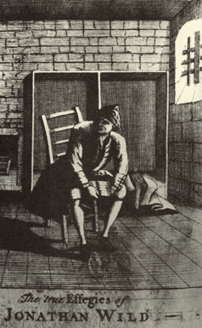
Accompanying the rise in concern about crime was a dramatic increase in writing about criminals. Criminal writing–in the form of broadsides, pamphlets, newspaper and magazine articles, and dramatic and prose literature–saturated the reading market. Criminals and their actions were one of the most popular topics for printed works, which recorded the acts of even the most common criminal. Some criminals became celebrities as a result of this focus on the criminal, and turnkeys at Newgate profited by charging polite society money to view in their jail cells the more famous criminals, like Jonathan Wild and Jack Sheppard. The large number of texts detailing the activities of known or executed criminals added to the commonly held notion that crime had reached epidemic proportions in the early eighteenth century.
All of these factors contributed to a real and perceived increase in crime. People believed that something had to be done to stop it, but unfortunately England’s criminal justice system, as it was currently constituted, was ill equipped to handle the new criminal underworld that was developing.
Resources for this article:
- Beattie, J. M. Crime and the Courts in England, 1660-1800. Princeton: Princeton UP, 1986.
- Bell, Ian A. Literature and Crime in Augustan England. New York: Routledge, 1991.
- Faller, Lincoln B. Turned to Account: The Forms and Functions of Criminal Biography in Late Seventeenth- and Early Eighteenth-Century England. New York: Cambridge UP, 1987.
- Linebaugh, Peter. The London Hanged: Crime and Civil Society in the Eighteenth Century
. New York: Cambridge UP, 1992.
- Thompson, E. P. Whigs and Hunters: The Origin of the Black Act. New York: Pantheon, 1975.
Learn More About Convict Transportation

Learn more about convict transportation to colonial America by reading my book, Bound with an Iron Chain: The Untold Story of How the British Transported 50,000 Convicts to Colonial America.
Amazon.com: Paperback ($16.99) and Kindle ($4.99).
Smashwords: All e-book formats ($4.99).
Most people know that England shipped thousands of convicts to Australia, but few are aware that colonial America was the original destination for Britain’s unwanted criminals. In the 18th century, thousands of British convicts were separated from their families, chained together in the hold of a ship, and carried off to America, sometimes for the theft of a mere handkerchief.
What happened to these convicts once they arrived in America? Did they prosper in an environment of unlimited opportunity, or were they ostracized by the other colonists? Anthony Vaver tells the stories of the petty thieves and professional criminals who were punished by being sent across the ocean to work on plantations. In bringing to life this forgotten chapter in American history, he challenges the way we think about immigration to early America.
The book also includes an appendix with helpful tips for researching individual convicts who were transported to America.
Visit Pickpocket Publishing for more details.


Post a Comment